Posts

Showing posts with the label relationships

Can AI save my chicken? (...and some thoughts on holding onto self in the midst of AI)

Image
As with a much of the world, I’ve been thinking a lot about AI. Being a millennial who didn’t grow up with a whole lot of technology I was initially quite resistant and avoided it... until recently when I had several research projects that required way more time than I was able to give. Faced with this challenge, I thought maybe AI could be useful, maybe it could help me double up my work output within the limited time I have available to me. So, I gave in and begun to experiment. Getting curious about my own resistance I realised I was concerned that it would make me stupid, that it would take away my own ability to think, analyse and communicate. I think this concern, although a bit reactive, was somewhat warranted, because as I began to experiment, I observed how quickly AI would take me away from the original task I had given it and send me into long unending twisty tunnels creating 20 new globally successful businesses and re-writing all of my work into internationally bestselling...

Is telepathy ruining my relationship?

Image
I was asked recently what is the most common challenge I see couples facing in my practice and I found it surprisingly easy to answer... can you guess?  Telepathy. The dictionary describes it as "the supposed communication of thoughts or ideas by means other than the known senses" . I'm not sure about you but I am yet to meet someone who can prove to me that they are indeed telepathic and able to read the minds of others. And yet, almost every couple that sits in front of me in therapy are behaving in ways that suggest they have the gift, and spoiler alert, it is not leading to enriching & satisfying relationships.  A fictitious example: Julia arrives home from work to her partner Rob. The house is a mess & Julia thinks to herself "Aargh, Rob is so lazy! He never helps out around the house, he knew I had a big meeting today couldn't he have at least tidied up a bit before I got home? He clearly doesn't care about how important my day was." Julia ...

Mature stepping back or anxious distancing?

Image
With many gatherings filling the months ahead I thought it could be useful to think about how we can use distancing as a way to manage stress & anxiety. Distancing can also be thought of as avoidance, it’s one of the most common ways we can manage discomfort - by not putting ourselves in situations or near relationships that cause it! But how helpful is this to us really? It might feel relieving in the moment to avoid facing that person or group of people that really get our heart rate pumping… however the problem is not being addressed & we’re not allowing ourselves to learn how to manage our stress (tolerate discomfort) in those situations, and so the intensity surrounding the relationship/s increases. And when relationship intensity increases, symptoms are likely to pop up. Sometimes a bit of distance is healthy & appropriate, like when unreasonable expectations are being placed on us or we are being pulled into filling in for another person’s vulnerabilities. Being able...

My therapist talks about triangles - what are they?

Image
You may have heard the term ‘triangles’ in systemic therapy before but what exactly does it mean?? Simply put, when tension develops between two people - a third person can be pulled in, in an attempt to ‘stabilise’ or ‘calm’ the tension between the 2. Then becoming what is known as a triangle, where the initial 2 people are then functioning in relation to the 3rd, dependent on the 3rd for relative & temporary harmony. There is often a pattern of 2 on the inside and 1 on the out, the person who is the outsider can shift depending on where the anxiety/tension presents. Like many Australians I grew up being a very big Silverchair fan, so I was fascinated to watch the recent series of Australian Story recounting the history of the band. What has occurred between the 3 band members is quite a clear example of a triangle. At different points in the bands career there has been significant anxiety/tension resulting in distance & now cut off. Chris & Ben have mended difficulties, n...

Managing anxiety during family gatherings

Image
Yep, that time of year is fast approaching! When you think of getting together with family does it provoke any anxiety? One of the best ways to prepare is to take time now to reflect on where that anxiety is coming from, getting curious about it, attempting to increase our awareness of how it manifests in our thinking, feeling & behaviour & asking ourselves is that really how we want it to be? This is not about being judgemental or critical, it’s about being interested. As you take time to reflect, it can be very helpful to come up with one or more research questions to take with you to these gatherings. For example, ‘what is my automatic response to conflict that arises?’ Or even extending this to ‘what is each person in my families default response when conflict occurs?’… can I notice any patterns & roles? What’s helpful or unhelpful? Being able to step back and be an observer, with the intent of learning more about ourselves and our family’s automatic patterns of functio...

Understanding cut off: a backing away from the relationship system

Image
I attended a fascinating webinar put on by  The Family Systems Institute  yesterday with Dr Anne McKnight discussing the complex systemic process of cut off. Not to be mistaken with more commonly known term ‘estrangement’ cut off refers to the relationship process of managing tension in a relationship by backing away from it. It’s purpose is to allow breathing room but it’s cost can be cutting off from a potential resource & lead to isolation. It can also have implications for how one functions in their own family. Cut off usually occurs in relationships when there is little capacity to be able to strategies in the face of tension and emotionality & is a mechanism to reduce tension by severing contact. It’s helpful to remember that when someone chooses to cut off they are just doing the best they can to adapt to the circumstances they face. However, in cut off we lose the valuable opportunity to work on our ability to manage difficulties in relationships. In thera...

Letting go of criticism

Image
I hear a lot of criticism in therapy. I hear it in two main forms: criticism of self and criticism of others - both of which can become entrenched patterns of anxious behaviour that can be very difficult to shift & that only tend to cause more anxiety as the outcome. One way I encourage clients to start tackling criticism is to first step back & become more aware of it. Spend time observing it, learning its ins and outs - when does it occur? How does it play out in my behaviour? Is the criticism based in something evidenced based that I truly believe in? How automatic is my response to it? Are there times I’m more critical than others? Have there been times I’ve been able to notice the critical thoughts but then let them go? What’s it like for me to sit with the thought & analyse it before I act on it? Questions for you: Are you aware of how criticism plays out in yourself and your relationships?  How well acquainted are you with how it functions for you right now?...

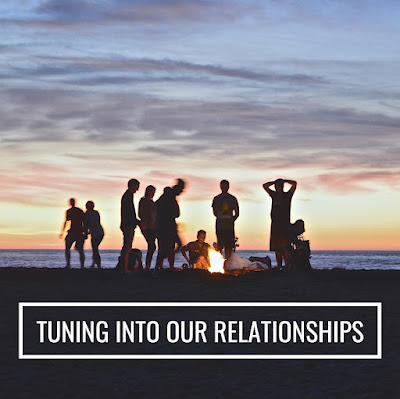
Tuning into relationships: a series on regulation

Image
The fourth factor impacting our capacity to regulate is relationships. This is the last one of this little series & potentially the most important! Most would say that this one is all about feeling understood, accepted & valued by those we care about & that this calms us down… which is not untrue! However this type of thinking can lead to dependency on others for our ability to remain calm. I have a slightly different focus on this one which comes from a Bowen family systems concept called ‘differentiation of self’. This concept refers to our ability to stay connected but autonomous in the face of relationship stress. A well differentiated person “can stay calm and clear headed enough in the face of conflict, criticism, & rejection to distinguish thinking rooted in a careful assessment of the facts from thinking clouded by emotionality.” In contrast “people with a poorly differentiated self depend so heavily on the acceptance and approval of others that they either quic...